Tuesday, April 28, 2009

Promises of politicians rub in salt on wounds of Kutch agariyas

BRAVING A TOUGH DESERT LIFE FOR CENTURIES, SALT PAN WORKERS WAIT ENDLESSLY FOR A SAVIOUR

ELECTIONS come and go, but the precarious world they live in never changes. These are the 43,000-odd agariyas or salt pan workers engaged in salt farming for eight months, from September to April, in the Little Rann of Kutch.
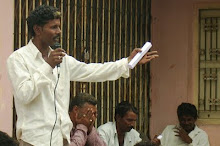
Hopes were raised in 2007, when just before the state Assembly elections Chief Minister Narendra Modi had organised an Agariya Kalyan Sammelan (salt pan workers welfare conference) at Kharaghoda in Surendranagar district. But, as Navgham Surda, one of the local community leaders of agariyas puts it, ” Things have moved at a snail’s pace.” Earning just over 15 paise per kg of salt produced and inhabiting an area spread over 5,180 sq km (also known as India’s Survey Number Zero, as no survey has been conducted here since Independence), these agariyas have been experiencing the toughest desert life for centuries. But with a few votes, and that too which is hardly ever exercised as they are away for most of the year, they have become politically irrelevant.
Though politicians, on their part, are never short of promises, what remains to be seen is the real implementation on ground.
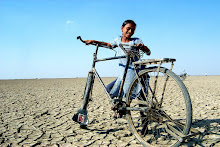
For example, during the conference in 2007, Modi had announced the government’s plan to develop the Navlakhi Port near the Little Rann, with a special jetty for salt export to give a big boost to its production. Other promises included a cycle per agariya family, mobile health vans, mobile schools, safety kits to help in salt farming as well as housing provisions in the 109 villages in the periphery of Little Rann.
Marut Bariya of Agariya Hit Rakshak Manch, an organisation trying to mobilise the community comprising the three de-notified tribes of Miyana, Sandhi and Chuvaliya-Koli, said: “Exploitation by big companies and rich traders leading to acute poverty among the agariyas, lack of basic amenities like drinking water and shelter, and safety tools like gumboots, sunglasses as well as healthcare, should be the issues, and not some grand development initiatives like a new port.” Now, with the proposed sanctuary for wild ass in the Little Rann and the government not renewing the leasing rights of agariyas, the salt pan workers are most likely to be deprived of their only source of livelihood.
Bheemani Jaresa, another agariya community leader, said: “Although some measures like a mobile ration shop and potable water supply through tankers are being initiated, these are certainly not enough. Our demand is that the government must introduce a Minimum Support Price for the salt produced by us on the same lines as given to farmers for agricultural produce.” The political parties must understand this is the only way to free agariyas from chronic poverty, he added.

Wednesday, April 22, 2009

Wild Ass Sanctuary, Little Rann of Kutch - UNESCO World Heritage ...

Wild Ass Sanctuary, Little Rann of Kutch
Property names are listed in the language in which they have been submitted by the State Party.
India (Asia and the Pacific) Date of Submission:15/03/2006
Category: Natural
Submited by: Nature Conservation Foundation and Ashoka Trust for Research in Ecologyand Environment
Coordinates: 220 55 N to 240 35 N 700 30 E to 710 45 E
Ref. : 2105
Description
The Wild Ass Sanctuary is located in the Little Rann of Kutch of the Gujarat State in India. It covers an area of 4954 km². The Sanctuary is named after a sub species of wild ass (Equus hemionus khur), the last population of which it harbours. The Rann is one of the most remarkable and unique landscapes of its kind in the entire world. It is a vast desiccated, unbroken bare surface of dark silt, encrusted with salts which transforms into a spectacular coastal wetland after the rains.The present saline desert of the Little Rann (saline desert-cum-seasonal wetland) of Kutch is believed to have been shallow sea. The variety of the geomorphic facets of Kutch such as the present surface configuration, its landforms, drainage characteristics and relief pattern clearly reveals a complex interplay of tectonics, sea-level changes and lithology as also erosion and deposition.The Rann can be considered a large ecotone, a transitional area between marine and terrestrial ecosystems. During monsoon, the Rann gets inundated for a period of about one month. It is dotted with about 74 elevated plateaus or islands, locally called 'bets'. The largest plateau called Pung Bet has an area of 30.5 km² and the highest island Mardak is 55 m.The vast cover of saline mudflats in the Sanctuary has no vegetation, except on the fringes and bets. Vegetation is largely xerophytic with the ground cover predominated by ephemerals. Their active growth is triggered by the advent of monsoon rains. Although the islands and fringes both have been colonized by Prosopis juliflora, the islands have a richer floral diversity than that of the fringes. 253 flowering plant species have been listed, out of which the number of species of trees was 18, shrubs-23, climbers/twiners-18, herbs-157 and grasses-37. Bets and fringe area of extensive marine saline flats of the Little Rann of Kutch mainly support a variety of indigenous plants like Suaeda spp., Salvadora persica, Capparis decidua, Capparis deciduas, Calotropis procera, Tamarix sp., Aeluropus lagopoides, Cressa cretica, Sporobolus spp., Prosopis Cineraria, etc. The dominant families representing more than 10 species are Fabaceae, Asteraceae, Cyperaceae and Poaceae. Herbaceous taxa are predominant over shrubs and trees. 107 species of algae are present in the water bodies of the area.The Sanctuary is habitat to about 93 species of invertebrates, including 25 species of zooplanktons, 1 species of annelid, 4 crustaceans, 24 insects, 12 molluscs and 27 spiders. Totally 4 species of amphibians (frogs and toads) and 29 species of reptiles (2 species of turtles, 14 species of lizards, 12 snakes and 1 crocodile) occur. The mixing of tidal water from the Gulf of Kutch with the freshwater discharged from the rivers takes place in the Little Rann of Kutch, making it an important spawning ground for prawns. Metapenaeus kutchensis is the most dominant and important prawn in the area. The sanctuary provides an important feeding, breeding and roosting habitat for a large number of birds due to its strategic location on bird migration route and its connection with the dynamic Gulf of Kutch. According to an estimate about 70,000-75,000 birds nests in an area spread over 250 acres. Nine mammalian orders with 33 species/subspecies have been reported from the Little Rann of Kutch, including the world’s last population of the khur sub-species of the wild ass.

Bounties of a bleak landscape

LAND & PEOPLE
DIONNE BUNSHA
The Little Rann of Kutch is hot, dry and salty, but it has rich biodiversity.
SALT overpowers you in the Little Rann of Kutch. It burns the insides of your nose. You can taste it on your tongue and lips. It makes your eyes run. All it takes is an hour in the Rann for salt to saturate your senses.
Imagine living here. In a flat land, with cracked earth and a bare horizon broken only by the occasional salt pan or sometimes a Bet (plateau or elevated island). The only people who survive in this harsh terrain are salt-pan workers known as Agarias, belonging to the Chuwalia Kolis caste, which comes under Other Backward Classes. Local legend has it that even after an Agaria is dead and cremated, the soles of his feet remain. A lifetime of hard work in the salt pans hardens their skin so much that even fire cannot burn it.
For eight months, the Agarias camp in the Little Rann to make salt. They make huts over pits dug in the ground to protect themselves from the wind and the sun. There is no water, no groceries, no school, no doctor... nothing near by. It is just them and the salt pans. They dig wells and use diesel pumps to draw water from the saline aquifers. It is essential that water keeps flowing through the salt pan without interruption so that salt crystals are formed properly. That is why Agarias cannot leave salt pans unattended and go back to their villages at the edges of the Little Rann.
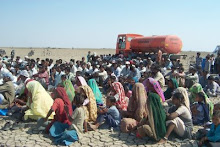
"We have to work like oxen every day, pulling the rake through the water. Look at these blisters on my hand. The salt is so blinding, I can't even see properly," said Bhavan Muladia, who had set up a salt pan with his brother. "There isn't even drinking water here. We buy water from a tanker that comes every five days. The water costs Rs.500 a month. We get to bathe every 15 days. That's why everyone keeps falling ill here."
Why do they continue to work in such severe conditions? "What else can we do? There's no other work. In the rains, we work in the villages on other people's farms. But after that there's nothing. Give us a choice and we'll leave."
Biodiversity
Who would believe that such inhospitable terrain supports so many people and very rich biodiversity? This region is home to the last surviving species of the Asiatic wild ass (Equus hemionus khur). It also has six threatened plant species, nine species of endangered mammals (wolf, caracal, desert cat, chinkara, blackbuck, blue bull), six threatened species of water birds (houbara bustard, lessor florican, spoon bill, peafowl, hawks, large falcons) and six vulnerable reptile species, according to a report prepared by the Gujarat Ecological Education and Research Foundation (GEER). Its waterbodies are home to many migratory water birds and are even the nesting grounds for lesser flamingos. Besides, there are 253 flowering plant species here.
In the past century, the Indian wild ass was found all over the dry regions of northwestern India and western Pakistan - Jaisalmer, Bikaner, Sind and Baluchistan. Today, it is found only in the Little Rann, and a few stray towards the Great Rann of Kutch. At the last count, in 1998, its population was estimated at 2,940.
The population has been growing since 1976. But as wild ass expert Nita Shah points out, long-term trends show intense fluctuations. Since the area is drought-prone, the wild ass population could decline suddenly. If there are no severe droughts, the species is likely to grow and disperse in the Great Rann and Rajasthan, habitats that the wild ass occupied in the past. The GEER report recommends that the Thar desert should be developed as an alternative site for the Indian wild ass.
While driving through the Rann, all you see is flat land and the sky and often mirages. When you see waterbodies teeming with birds, it is a surprise. The Rann's strategic location and connection to the Gulf of Kutch make it a rich habitat for 97 species of water birds and 81 species of terrestrial birds. Nine migratory bird species also visit the Rann. The Rann also has a unique saline grassland called Banni where endemic salt-tolerant grasses grow.
"Biodiversity in these areas has remained remarkably intact because of cultural values, social controls and indigenous knowledge, which are maintained and enforced by community institutions such as panchayats," says Prof. Anil K. Gupta from Sristi, an organisation that works to build local knowledge. "Community-managed areas also harbour a large part of Gujarat's domestic biodiversity and agro-biodiversity. The survival of indigenous varieties of cattle, sheep, horse and crops is linked with the continuation of these areas."
The Little Rann of Kutch was once part of the Gulf of Kutch. It is a unique seasonal wetland; it remains totally submerged during the monsoon, but transforms into a desert for the rest of the year. During the monsoon, tidal waters and water from rivers such as the Banas, the Rupen and the Saraswati flood the mudflats. This intermingling of waters makes the Rann a vast fishing ground during the monsoon, particularly for prawns. A narrow highland near Adesar connects the Little Rann to the Great Rann of Kutch.
Fossils from Jurassic times are found on some islands, so the region also has tremendous geological importance. The government plans to make it a biosphere reserve - where the needs of people and the environment are considered in conservation management.
Although the Little Rann was declared a sanctuary in 1973, the decision has not been implemented because the government still has not settled the claims of the 50,000 Agarias and 8,650 fishermen here. Until settlement is complete, the Forest Department cannot take measures to manage or protect the sanctuary.
As we drive through the Rann in an old, battered jeep, Devjibhai Dhamecha, a local naturalist, tells us: "Tourists want to see the lion in Gir, but no one is interested in wild asses. That's why Gir's protected area is 1,100 sq km but has 600 forest staff. That's two people for each lion. The Little Rann is spread across 5,000 sq km but we have only 35 persons posted here. And they can't do much to control growth here because the settlement of the sanctuary hasn't been completed in the last 30 years."

Decades of unregulated development have taken their toll on the ecosystem. Grazing cattle and sheep have eaten into space where wild animals forage. Wild ass expert Nita Shah, one of the authors of the GEER report, says that changes in land use patterns in the villages surrounding the Little Rann have resulted in more wildlife-animal conflict. Unregulated vehicle traffic within the Little Rann has also disturbed bird and animal life.
The GEER Foundation report says that "[unregulated growth of] salt works have resulted in the loss of habitat, hindered the movement of wildlife, increased disturbance levels and threatened the breeding site of flamingos". One-third of the salt produced in Gujarat (which is the country's largest salt producer) is made in the Little Rann. The rights of salt-makers cannot be ignored. The GEER report, funded by the Gujarat Forest Department, proposed that salt pans be restricted to seven zones on the outskirts of the sanctuary, leaving the interiors for wildlife. The government says it is planning to implement it once the settlement process is complete. However, Pradeep Khanna, Gujarat's Chief Conservator of Forests, was reluctant to talk about any details regarding the settlement process.
The land in the Little Rann does not belong to individuals. But the government has granted leases allowing people, societies and even companies to manufacture salt. While individuals have leases that extend from 10 to 20 years, companies have longer leases, one stretching up to 100 years. Only those salt workers holding leases issued before January 12, 1973, will be considered `legal' while settling claims. A large majority, considered `illegal', will lose their only source of livelihood. Moreover, the rights of those who have sub-leased salt pans from merchants may have no legal standing.
PRECARIOUS EXISTENCE
If given another option, they would gladly give up salt harvesting. Still exploited by traders and middlemen, they have no way out of the grind. "They live like slaves in a free country. They are totally tied to merchants for getting leases and loans, buying diesel for their pumps, and finally selling the salt," says Dhamecha, who also comes from an Agaria family. "Agarias sell their salt for 60 paise a kg, but the market price is Rs.6 a kg, so you can imagine the extent of exploitation." Earnings from the salt pans are diminishing, as the water table falls and the salt-makers have to spend more to pump water. Some have had to abandon salt pans half way through the salt-producing process because there was not enough water. Salt pans have become an even more risky venture.
For the first time, Premji Muladia has to dig a second well in his salt pan. The first one ran dry. He is expecting lower production this year. "The water this year isn't as saline, so I think I will get only 750 tonnes this year. Last year I got 950 tonnes. I won't have any money left at the end of the season," he says. "Expenses are increasing because there is less water. Even after putting in so much work, we may not get much salt."
As the government keeps delaying the settlement and the putting of a proper co-existence plan into practice, people like Premji Muladia and their endangered ecosystem are treading a thin line for survival. They need more than just salt to sustain them.
http://www.hinduonnet.com/fline/fl2308/stories/20060505000406600.htm